
1. Executive Sourcing Overview & Chemical Intelligence
In the global B2B botanical ingredient landscape, Rutin Powder (CAS Registry Number: 153-18-4), chemically designated as Quercetin-3-O-rutinoside or sophorin, represents one of the most commercially critical bioflavonoid glycosides. Derived primarily from the dried flower buds of Sophora japonica L. (Japanese Pagoda Tree / Flos Immaturus Sophorae), Rutin serves as a primary active raw material for pharmaceuticals, dietary supplements, functional beverages, and advanced cosmeceuticals.
As global regulatory bodies intensify scrutiny over ingredient purity, heavy metals, and botanical identity, procurement officers must look beyond simple price-per-kilogram metrics. Understanding the subtle analytical distinctions between UV-Vis spectrophotometry and High-Performance Liquid Chromatography (HPLC) assay testing, solvent residue profiles, particle size distribution, and crystalline polymorphism is essential to safeguard brand integrity and secure competitive formulation advantages.
While Rutin occurs naturally in fagopyrum esculentum (buckwheat), eucalyptus leaves, and citrus peels, commercial-grade high-purity Rutin Powder (≥95% to 98% HPLC) is almost exclusively manufactured from Sophora japonica L. flower buds. Sophora japonica contains an uncommonly high concentration of native Rutin (up to 15%–20% in raw unexpanded buds), offering superior extraction yields, lower baseline impurity matrices, and a cleaner botanical fingerprint compared to buckwheat-derived flavonoids.
Chemical Profile & Structural Characteristics
Rutin consists of the flavonol Quercetin bound to the disaccharide Rutinose (a-L-rhamnopyranosyl-(1→6)-β-D-glucopyranose) at the C-3 hydroxyl position. This glycosidic linkage imparts significant chemical stability against oxidation compared to aglycone Quercetin, though it simultaneously limits lipophilicity and aqueous solubility in native forms.
- IUPAC Name: 2-(3,4-dihydroxyphenyl)-5,7-dihydroxy-3-[(2S,3R,4S,5S,6R)-3,4,5-trihydroxy-6-[[(2R,3R,4R,5R,6S)-3,4,5-trihydroxy-6-methyloxan-2-yl]oxymethyl]oxan-2-yl]oxychromen-4-one
- Molecular Formula: C27H30O16 (anhydrous) / C27H30O16·3H2O (trihydrate standard)
- Molecular Weight: 610.52 g/mol (Anhydrous) / 664.56 g/mol (Trihydrate)
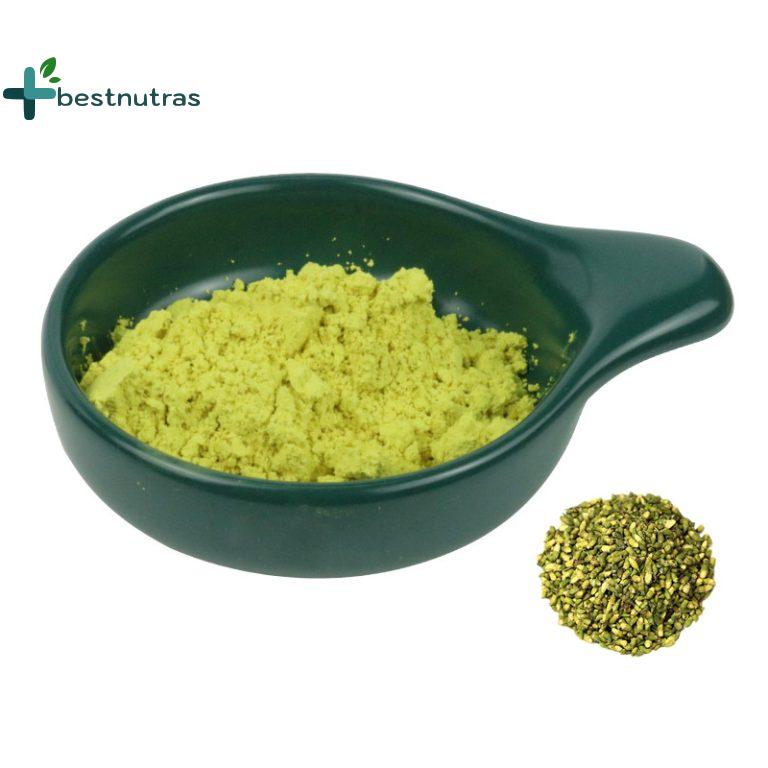
- Appearance: Fine greenish-yellow to bright yellow crystalline powder
- Solubility: Slightly soluble in water (~125 mg/L at 25°C); freely soluble in alkaline solutions and pyridine; soluble in hot ethanol and methanol; practically insoluble in diethyl ether, chloroform, and petroleum ether.
2. Standardized Rutin Powder Product Portfolio & Grade Comparison
At KNH Biotech Co., Ltd., we process premium Sophora japonica raw materials through customized extraction lines to yield distinct pharmacopeial and industrial grades tailored to global compliance standards including National Formulary (NF11), German Pharmacopoeia (DAB10), and European Pharmacopoeia (EP).
| Specification Parameter | NF11 Grade (USP Standard) | DAB10 Grade | EP Grade (European Pharm) | Water-Soluble Derivatives |
|---|---|---|---|---|
| Assay Method & Purity | ≥ 95.0% - 101.5% (HPLC / UV) | ≥ 98.0% - 102.0% (UV/HPLC) | 95.0% - 101.0% (HPLC) | Custom derivatives (≥20% - 98% soluble) |
| Appearance | Yellowish-green powder | Bright yellow powder | Fine yellow microcrystalline | Off-white to light yellow powder |
| Loss on Drying | 5.5% - 9.0% (Trihydrate) | ≤ 9.5% | 7.5% - 9.5% | ≤ 5.0% |
| Residue on Ignition / Ash | ≤ 0.3% | ≤ 0.2% | ≤ 0.1% | ≤ 0.5% |
| Heavy Metals (Total) | ≤ 10 ppm | ≤ 10 ppm | ≤ 10 ppm (Strict ICP-MS) | ≤ 10 ppm |
| Lead (Pb) / Arsenic (As) | Pb ≤ 2 ppm | As ≤ 1 ppm | Pb ≤ 1 ppm | As ≤ 1 ppm | Pb ≤ 0.5 ppm | As ≤ 0.5 ppm | Pb ≤ 1 ppm | As ≤ 1 ppm |
| Quercetin Impurity (HPLC) | ≤ 5.0% | ≤ 3.0% | ≤ 1.5% | ≤ 2.0% |
| Mesh Size / Granulometry | 95% through 80 Mesh | 98% through 80 Mesh | 100% through 100 Mesh | 99% through 100 Mesh |
| Microbial Controls | Total < 1,000 cfu/g | Mold < 100 cfu/g | Total < 1,000 cfu/g | Mold < 100 cfu/g | Total < 500 cfu/g | Salmonella Negative | Total < 1,000 cfu/g | E. coli Negative |
Product Recommendations for Formulators & Brand Owners
Selecting the appropriate Rutin grade depends directly on your delivery system, regulatory target market, and target claims:
The global benchmark for hard-shell gelatin and vegetable capsules, compressed dietary tablets, and traditional herbal formulations focusing on circulatory support and capillary strength.
Contact Us
Engineered for European pharmaceutical and premium nutraceutical compliance. Features stringent residual solvent limits, minimal quercetin hydrolysis products, and micro-particle uniformity.
Contact Us
Solubility-enhanced modifications for functional beverage shots, ready-to-mix powders, liquid drops, and high-performance topical serums where native precipitation must be eliminated.
Contact Us3. Industry Trends & R&D Breakthroughs: Overcoming Bioavailability Barriers
Historically, the primary bottleneck in Rutin market expansion was its poor oral bioavailability. Native Rutin is poorly absorbed in the upper gastrointestinal tract due to its high molecular weight, low lipophilicity, and low water solubility. Microorganisms in the colon hydrolyze Rutin into its aglycone form, Quercetin, which is subsequently absorbed and conjugated. However, modern biotechnology has unlocked sophisticated solutions:
A. Enzymatically Modified Isoquercitrin (EMIQ) Conversion
By utilizing specific glycosyltransferases, food scientists can selectively remove the rhamnose sugar moiety from Rutin, converting it to Isoquercitrin (Quercetin-3-O-glucoside), and subsequently attach additional glucose chains. The resulting Enzymatically Modified Isoquercitrin (EMIQ) demonstrates up to 17x to 18x higher plasma absorption compared to un-modified Rutin Powder. This technological breakthrough is rapidly replacing conventional flavonoids in premium sports recovery beverages and neuroprotective supplements.
B. Hydroxyethylation to Produce Troxerutin (Pharmaceutical Grade)
Through controlled chemical modification of Rutin extracted from Sophora japonica, Troxerutin (Trihydroxyethylrutin) is synthesized. Troxerutin possesses high aqueous solubility and enhanced venous tonicity, making it an essential active ingredient in pharmaceutical preparations for treating chronic venous insufficiency (CVI), varicose veins, hemorrhoids, and diabetic retinopathy.
C. Phytosome & Liposomal Encapsulation Delivery Systems
B2B buyers in North America and Western Europe are increasingly demanding Phytosomal Rutin—complexing Rutin molecules with non-GMO sunflower or soy lecithin phospholipids. Liposomal Rutin powders prevent stomach acid degradation, facilitate passive lymphatic absorption, and allow brands to claim superior cellular bio-efficacy with smaller dosages.
- Vascular & Microcirculation Matrix: Rutin Powder (300mg) + Hesperedin (150mg) + Micronized Diosmin (450mg) + Vitamin C (200mg). Demonstrates clinical synergy in maintaining capillary resistance and lymphatic drainage.
- Anti-Glycation Cosmetic Actives: Rutin (1.0% topical formulation) + Ferulic Acid + Vitamin E. Inhibits Advanced Glycation End-products (AGEs) formation, preserving dermal collagen networks and protecting against UV-induced ROS.
- Systemic Anti-Inflammatory Blend: Rutin Powder + Bromelain (2400 GDU/g) + Quercetin + Curcuminoids. Targeted at joint flexibility, post-exercise recovery, and vascular inflammation reduction.
4. Future Procurement Trends & Supply Chain Risk Mitigation (2025–2030)
The global demand for Rutin Powder is projected to experience strong compound annual growth (CAGR > 6.2%), driven by aging populations in North America, Japan, and Europe, alongside expanding applications in nutricosmetics. Procurement managers must prepare for several critical supply chain shifts:
1. Transition from UV-Vis to Mandatory HPLC Analytical Verification
Historically, low-cost suppliers utilized UV spectrophotometry to test Rutin content. However, UV testing is vulnerable to false positives caused by extraneous polyphenolic compounds or added quercetin spikes. Global regulatory authorities (including the US FDA and EFSA) are adopting mandatory High-Performance Liquid Chromatography (HPLC) testing protocols. Sourcing standard NF11 or EP Rutin that guarantees HPLC purity without adulteration is vital to avoid import detentions and costly recall events.
2. Decarbonized Ethanol-Water Crystallization & Solvent Safety
Older industrial extraction techniques used toxic organic solvents such as methanol, benzene, or chlorinated alkanes. Modern eco-conscious brands require strict solvent residue limits compliant with ICH Q3C Guidelines. KNH Biotech Co., Ltd. utilizes a green ethanol-water closed-loop crystallization process, ensuring methanol residual is non-detectable and ethanol residues fall well below 5,000 ppm (typically < 500 ppm).
3. Rigorous Pesticide & Ethylene Oxide (EtO) Screening
With the European Union reinforcing Regulation (EC) No 396/2005, agricultural raw materials face multi-residue pesticide screens covering over 500 active compounds. Furthermore, Ethylene Oxide (EtO) and its metabolite 2-chloroethanol contamination are zero-tolerance issues in EU ports. Strategic procurement requires buying directly from manufacturers with fully traceable Sophora japonica cultivation bases that enforce zero-EtO sterilization technologies (such as steam sterilization or gamma irradiation upon client request).
5. Enterprise Advantage: Why Partner with KNH Biotech Co., Ltd.
Established in 2010, KNH Biotech Co., Ltd. has established itself as an authoritative leader in botanical extraction, functional food additive manufacturing, and OEM/ODM private label solutions. Our production ecosystem is engineered specifically to eliminate quality uncertainty for global B2B buyers.
Raw Material Traceability
Direct sourcing from audited Sophora japonica agricultural bases ensures optimal harvesting timed specifically to peak bud flavonoid density, minimizing seasonal chemical variation.
Triple-Stage Testing & COA Transparency
Every commercial lot undergoes raw material verification, in-process testing, and finished batch analysis via Agilent HPLC, GC-MS, and ICP-MS for absolute purity verification.
State-of-the-Art CGMP Facility
Our extraction lines operate under certified CGMP, ISO 22000, USDA Organic, Halal, and Kosher quality systems, ensuring flawless international regulatory clearance.
Turnkey OEM / ODM Solutions
Beyond raw powder supply, we provide custom formulation, micronization, granular pre-blending, and finished dosage manufacturing (capsules, tablets, softgels, gummies).
Global Logistics & Bulk Stock Availability
We maintain strategic inventory reserves of standardized Rutin Powder (≥95% HPLC / NF11 / EP) in temperature-controlled warehouses to support rapid order fulfillment. Whether you require 25kg drum quantities for pilot batch formulation or multi-ton container shipments for global distribution, KNH Biotech Co., Ltd. delivers reliable lead times and competitive factory-direct pricing.
6. Global Procurement FAQ: Sourcing Rutin Powder
Address common technical, regulatory, and logistics queries frequently raised by global procurement officers and formulation scientists:
- Utilizing modified derivatives such as Troxerutin or Enzymatically Modified Isoquercitrin (EMIQ).
- Formulating with alkaline solubilizers or co-solvents (such as propylene glycol or ethanol in liquid products).
- Utilizing physical liposomal entrapment or cyclodextrin complexation technologies offered by KNH Biotech.
Request Your Bulk Rutin Powder Quotation & Specification Dossier
Partner with KNH Biotech Co., Ltd. for certified quality, competitive direct-from-factory pricing, and complete technical support. Click below to connect with our technical sales specialists instantly.